





Thun vedute
OVERVIEW
Below you will find Thun vedute, many of which are still available for purchase. We have also compiled information about Thun vedute painting.
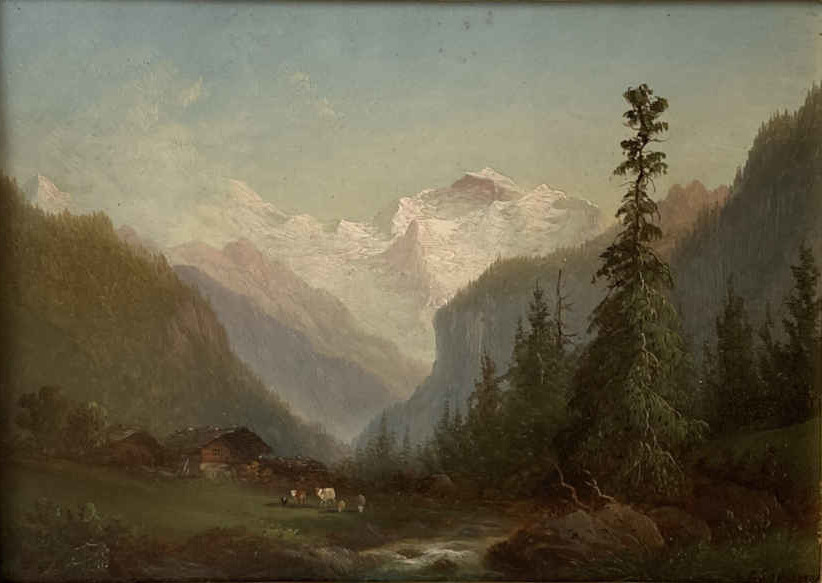
Buy Thun vedute
Here you will find Thun vedute for sale, although some pieces have already been sold.
-
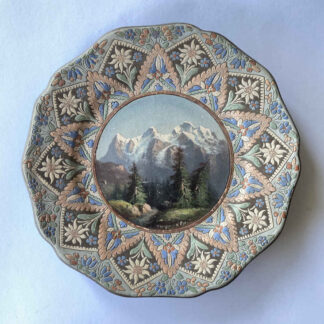
Johann WANZENRIED (* 1847, † 1895) – Plate Depicting Wengernalp – Thun Majolica (Thoune)
$429.40incl. shipping by post
Delivery time: 7-14 days
Add to cart -
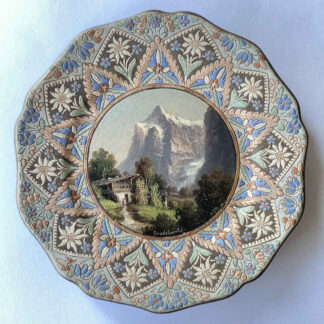
Johann WANZENRIED (* 1847, † 1895) – Plate depicting Grindelwald (Jean Stauffer) – Thun majolica (Thoune)
$429.40incl. shipping by post
Delivery time: 7-14 days
Add to cart -
![Ferdinand SOMMER (* 1822, † 1901)[attributed to] - Cabin in front of the Jungfrau – Veduta Painting](https://www.robertzueblin.com/wp-content/uploads/ferdinand-sommer-veduta-painting-cabin-front-jungfrau-photo-title-324x324.jpg)
Ferdinand SOMMER (* 1822, † 1901)[attributed to] – Cabin in front of the Jungfrau – Veduta Painting
$468.95incl. shipping by post
Delivery time: 7-14 days
Add to cart -

MUSÉE CÉRAMIQUE – Jungfrau (August Louis Ritschard) – Large Thun Majolica plate
$1,559.40Delivery time: 7-14 days
Add to cart -

Thun Majolica – Small Plate Depicting the Rütli Meadow in front of the Grosser and Kleiner Mythen Mountains
$316.40incl. shipping by post
Delivery time: 7-14 days
Add to cart -

MUSÉE CÉRAMIQUE – Thun Picture Plate Wellhorn Mountain and Wetterhorn Peak – Thun Majolica (Thoune)
Sold -

Hippolyte ROUX (* 1852, † ?) – Panorama Oil Painting Wetterhorn Schreckhorn Eiger Mönch Jungfrau Staubbach Falls
$474.60incl. shipping by post
Delivery time: 7-14 days
Add to cart -

Wooden Box with Veduta for Stamps – Veduta Painting
$135.60incl. shipping by post
Delivery time: 7-14 days
Add to cart -

Johann WANZENRIED (* 1847, † 1895) – Painted plate – Wellhorn and Wetterhorn – Thun Majolica (Thoune)
Sold -
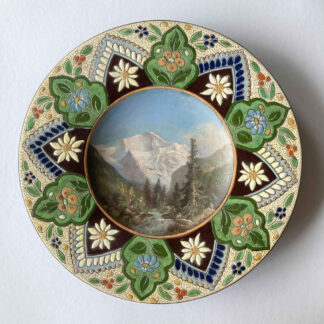
Johann WANZENRIED (* 1847, † 1895) – Wall Panel with Oil Painting – Jungfrau – Thun Majolica (Thoune)
Sold -

Johann WANZENRIED (* 1847, † 1895) – Dents du Midi veduta plate – Lake Geneva – Thun majolica (Thoune)
Sold -
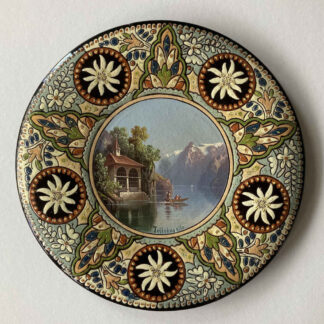
Thun ceramic plate with Tell’s chapel – Thun majolica (Thoune)
Sold -
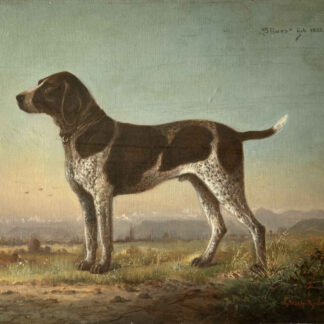
Gottfried STÄHLY-RYCHEN (* 1840, † 1920) – English Pointer in Landscape – Dog Portrait Oil Painting
Sold -

Ferdinand SOMMER (* 1822, † 1901) – Veduta painting of the Eiger, Mönch and Jungfrau
Sold -
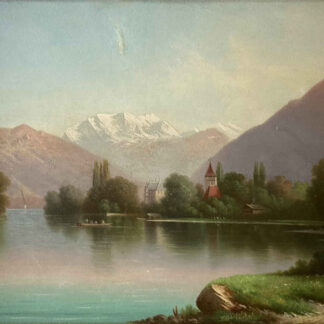
Marie EGG (* 1873, † 1959) – Schadau Castle – Veduta painting
$429.40incl. shipping by post
Delivery time: 7-14 days
Add to cart -

Marie EGG (* 1873, † 1959) – Tell’s Chapel – Uri Rotstock – Veduta Painting – Oil Painting
$248.60incl. shipping by post
Delivery time: 7-14 days
Add to cart
Beginnings and precursors
Veduta painting originated in the 18th century, primarily in Venice, and belongs to the genre of landscape painting, although each genre had its own purpose.
Interest in vedute in Switzerland arose later than in neighbouring countries, as the inhabitants of the Alpine region feared the mountains, which they perceived as threatening.
With the rapprochement with nature in the 18th century and the contribution of poets such as Albrecht von Haller and Salomon Geßner, as well as the travelogues of Goethe and Lord Byron, interest in mountain hiking grew. The German artist Caspar Wolf discovered the Alps as a motif in the 18th century. Albrecht Kauw painted the Thun area, especially Lake Thun, as early as the 17th century.
In Switzerland, specifically in Bern, Johann Ludwig Aberli is considered the founder of vedute. After a trip to the Alps, he produced watercolours and oil paintings. Later, he reproduced them as outline engravings (outline drawings). He was followed by Heinrich Rieter, Joseph Simon Vollmar, and Sigmund Freudenberger in Bern, and Marquard Wocher, Peter Birmann, and Johann Jakob Biedermann in Basel. After the invention of lithography, local artists used this technique to produce vedute. Their success was limited because black-and-white images were not in high demand.
The precursors of veduta painting were artists such as Marquard Wocher, Anton Winterlin and Jakob Suter, as well as English visitors to the area.
The second half of the 19th century was significantly more important for the genre of veduta painting. The phenomenon of veduta painting existed in Switzerland only in Thun and the surrounding area; there were around 30 Swiss and Thun veduta painters, who also painted other areas of Switzerland. Both François Diday and Alexander Calame had a strong influence on Thun vedute and Thun vedute painters.
The rise of Thun vedute
There is an economic reason why the Thun veduta industry developed in the Thun region. With the decline of the wine harvest in the region, the population had to look for an alternative to secure their income. Various buildings were converted into workshops. The majority of the population found new employment in the new craft of Thun souvenir production, which included not only Thun vedute but also Thun majolica and Brienz wood carving.
On the other hand, the emergence of new transport routes promoted tourism. In 1834, the ‘Bellevue’ estate was converted into a hotel.
In addition, Ferdinand Sommer, a painter from Coburg (Germany), settled in Thun in 1855. He saw an economic opportunity in the production of paintings from this area and can be considered the founder of Thun veduta painting. He also gave painting lessons; his pupils included Adolf Hänni and Ferdinand Hodler. Sommer’s landscapes of the Bernese Oberland were very popular at the time.
The case of Louis Hänni
Another important factor in the flourishing of Thun vedute was Louis Hänni, a trained cabinetmaker who founded a souvenir factory in the 1870s. In 1876, he and his brother Friedrich built the house at Lauenen No. 45, which served as the family residence and headquarters of the souvenir factory. The house at No. 50 was built by his other brother, the painter Adolf. Many of the painters also found accommodation with the Hännis, especially when the descendants gradually left the house. Louis Hänni succeeded in inspiring many young people to join his projects and then became a painter himself. His teachers were two of Ferdinand Sommer’s pupils: Gottlieb Dietrich and his brother Adolf.
Louis Hänni, who called himself a ‘negotiant’, exported Thun souvenir products and wood carvings as far as France. Among the products he sold were not only pictures, but also wood carvings produced by his own two carvers. However, Hänni also sold some of the goods produced by the approximately 2,000 carvers who were active in the Bernese Oberland at the time, for example in Brienz.
Other artists
Another souvenir manufacturer was Christian von Allmen, who also produced Thun vedute with his children. An artist named Déneiraz is said to have painted for tourists on Lake Geneva. Other individual painters included Edi Schilling, Jules Thorimbert and Eduard Bühler.
The reason why other artists in the region did not engage in vedute painting is said to be that no one showed them how.
Thun vedute paintings
It was Ferdinand Sommer (* 1822, † 1901) who introduced mass production to the Thun vedute. Each journeyman specialised in a different part of the picture: sky, mountains, architecture or trees. These journeymen had to work in a coordinated manner in the workshop. The Lauen painters, on the other hand, worked at home and were able to paint entire pictures on their own and also personalise them.
The postcard-sized formats were produced in large quantities and were often unsigned. The larger pictures were painted by selected painters and monogrammed. Paintings on canvas were commissioned separately.
The pictures were painted on Bristol board. First, white paint was applied with a kind of cotton wool ball, which was called ‘making the grain’. At the Hänni factory, the back was coated with colourless varnish to prevent the board from warping. These were activities that were usually done on winter evenings.
In daylight, the motifs were then copied from a template and finally coated with a slightly glossy varnish. The pictures had to dry in a dust-free place, and the temperature had to remain above 20°C for the varnish to be applied. In Albert Schaufelberger’s book ‘Die Thuner Vedutenmaler’ (The Thun Vedute Painters), annual production is estimated at 100,000 pieces, produced by around 30 vedute painters.
Other types of products featuring vedute
Parallel to the production of vedute, the 1880s saw a boom in Thun Majolica in Heimberg and the surrounding area. This type of ceramics featured rich decorations in various colours, which were usually applied to a brown background. The decorations were often inspired by oriental designs, which were mixed with Alpine motifs, especially the edelweiss flower. Since it was possible to decorate ceramic plates and rösti plates in particular with vedute, a collaboration developed between the two areas of Thun majolica and Thun vedute. The suppliers of ceramic items included the factory of Karl Loder-Eyer, who did not have his own distribution network, and the factory of Johann Wanzenried.
However, the vedute were also painted on metal bells, for example, which were imported from Germany.
The Hänni factory also used its own carpentry workshop to produce wooden boxes decorated with vedute.
Periods of vedute painting
The author Albert Schaufelberger (Louis Hännis’ son-in-law) of the book ‘Die Thuner Vedutenmaler’ (The Thun Vedute Painters) speaks of three periods of Thun vedute painting:
The first lasted until 1888 and is said to have enjoyed greater artistic freedom. Artists had a choice both in the location of a particular motif and in the technique and colour scheme used. The influence was still rather romantic: with dark tones, clouds, evening sunshine and small figures that emphasised the sublime.
In the second period, which lasted until around 1910, one can see the influence of Impressionism, which was in vogue at the time. The use of black was dispensed with and artists tried not to mix the colours on their palettes too much. The sky was painted uniformly blue and the mountains had violet tones. Human figures were no longer interesting. At the Hänni factory, Gottlieb Dietrich also created larger formats, which were correspondingly more expensive.
Louis Hänni also exhibited his products at the 1889 World’s Fair in Paris and was able to make many contacts that enabled him to sell worldwide. What Swiss tourism had done for the souvenir industry in the past, exported souvenirs then did for tourism in Switzerland.
In 1910, Rudolf Immer painted an idealised view using a different colour combination, which changed the style of many other artists. The colour green became the main feature of the picture. The colours were left practically as they came out of the tube, which also encouraged outdoor painting. With the decline in tourism, work in souvenir production slowly dried up and the painters found a source of additional income in the production of larger formats, which were now sold to established Thun families.
Ferdinand Hodler, who spent three years in Thun with his teacher Ferdinand Sommer, returned to Thun time and again for his own landscape paintings, bringing new painting fashions from Geneva. Hodler is also said to have influenced the Thun veduta painters to paint outdoors. The influence of veduta painting in Hodler’s work is certainly noticeable.
The end of Thun veduta painting came gradually between the end of the First World War and 1930. Ultimately, Thun vedutas were replaced by photography.