





THUN MAJOLICA (Thun ceramics)
Thun majolica (Thuner Majolica) is a type of souvenir art that involves Swiss ceramics from the Thun area (Thoune), in particular Heimberg and Steffisburg. In the heyday of Thun majolica around 1880, vases, crockery, picture and coat of arms plates were produced – mainly for tourists.
During the popular period of historicism, Thun ceramics were based on historical forms and were often decorated with oriental patterns, which were adapted to Swiss symbolism with edelweiss flowers, among other things.
Buying Thun Majolica
Below you will find pieces for sale that are categorised as Thun majolica or at least in the Thun majolica style. Not all pieces that look like Thun majolica actually come from the Thun area. Pieces labelled with ‘Thun’, ‘Thoune’ and/or the mark of a workshop from the Thun area – for example from Steffisburg or Heimberg – are counted as ‘Thun majolica’ in the narrower sense; all pieces not labelled accordingly are only counted as ‘Thun majolica’ style.
-

Thun Majolica – Plate Featuring a Woman in Traditional Mühlenbach Attire from the Black Forest
Sold -

Thun Majolica – Plate Featuring a Woman in Gutach Traditional Costume Wearing a Red Bollenhut from the Black Forest
Sold -
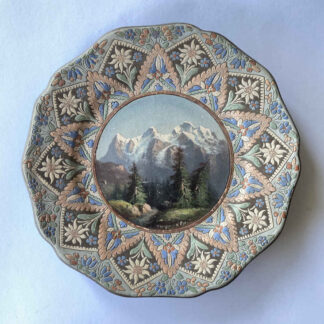
Johann WANZENRIED (* 1847, † 1895) – Plate Depicting Wengernalp – Thun Majolica (Thoune)
$429.40incl. shipping by post
Delivery time: 7-14 days
Add to cart -
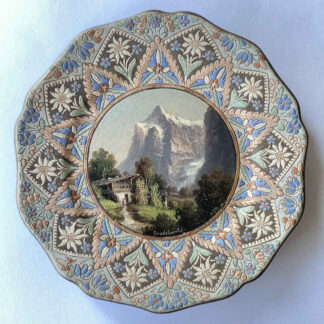
Johann WANZENRIED (* 1847, † 1895) – Plate depicting Grindelwald (Jean Stauffer) – Thun majolica (Thoune)
$429.40incl. shipping by post
Delivery time: 7-14 days
Add to cart -

MUSÉE CÉRAMIQUE – Black Coffee Pot with Figure-eight bow – Thun majolica
$542.40incl. shipping by post
Delivery time: 7-14 days
Add to cart -

Thun Majolica – Cat (black) as Teapot/Coffee Pot
$1,107.40incl. shipping by post
Delivery time: 7-14 days
Add to cart -

Johann WANZENRIED ( * 1847, † 1895) – 3 Mocha Sets – Thun Majolica (Thoune)
$305.10incl. shipping by post
Delivery time: 7-14 days
Add to cart -

MUSÉE CÉRAMIQUE – Jungfrau (August Louis Ritschard) – Large Thun Majolica plate
$1,559.40Delivery time: 7-14 days
Add to cart -

Thun Majolica – Plate with Lucerne Chapel Bridge in front of Mount Pilatus
$429.40incl. shipping by post
Delivery time: 7-14 days
Add to cart -

Thun Majolica – Small Plate Depicting the Rütli Meadow in front of the Grosser and Kleiner Mythen Mountains
$316.40incl. shipping by post
Delivery time: 7-14 days
Add to cart -
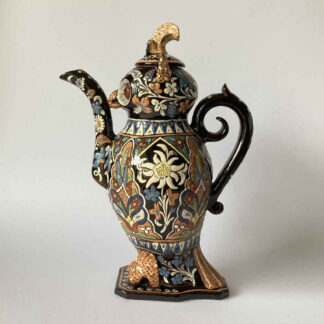
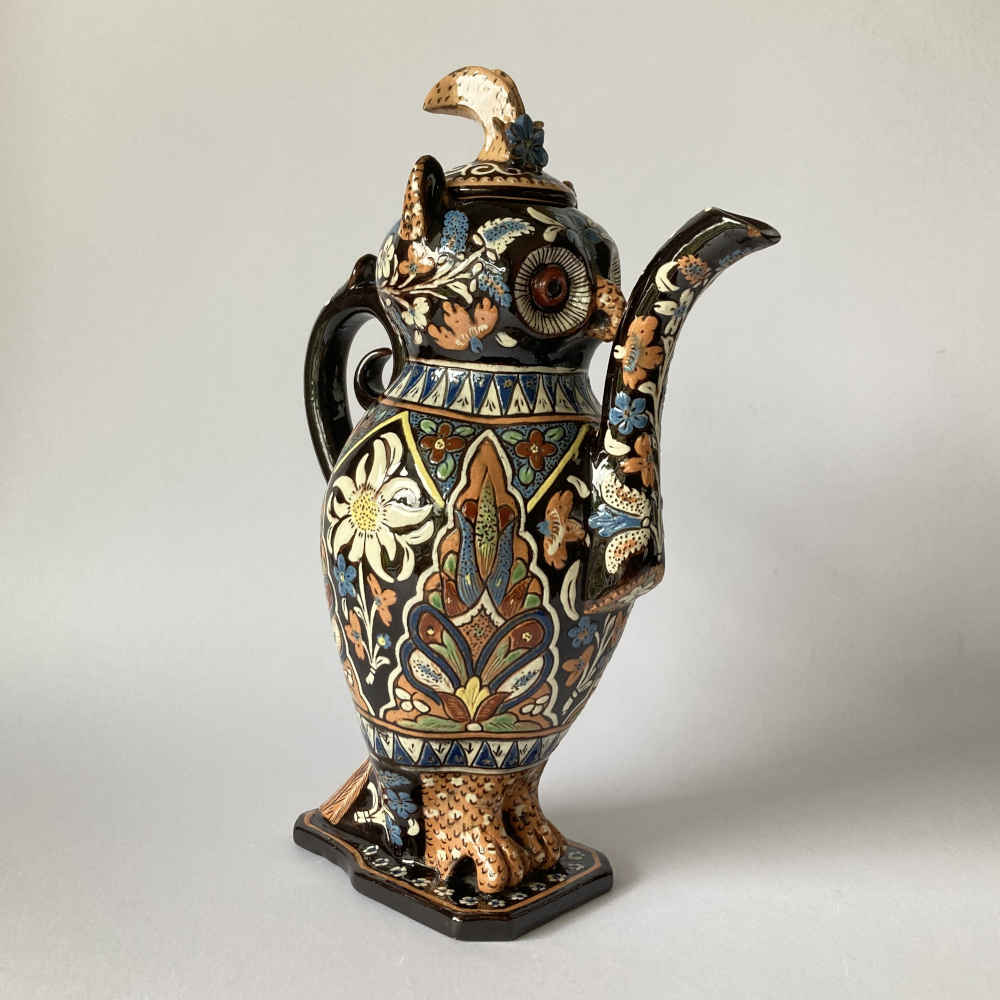
Thun Majolica – Owl Teapot / Coffee Pot with Blue Flower on Head Feather
$1,107.40incl. shipping by post
Delivery time: 7-14 days
Add to cart -

HANS TSCHANZ Manufactory – Cat Teapot / Coffee Pot – Thun Majolica
$994.40incl. shipping by post
Delivery time: 7-14 days
Add to cart -

Friedrich Ernst FRANK (* 1862, † 1920) for Johann WANZENRIED – Thun Majolica Plate with Knight from the XVIth Century
$316.40incl. shipping by post
Delivery time: 7-14 days
Add to cart -

Friedrich Ernst FRANK (* 1862, † 1920) for Johann WANZENRIED – Thun Majolica Plate with Noble Lady from the XVIth Century
$316.40incl. shipping by post
Delivery time: 7-14 days
Add to cart -
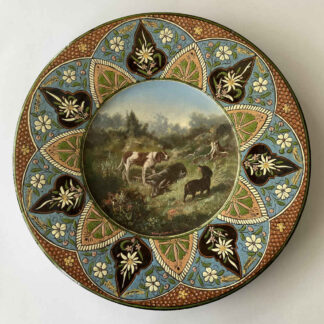
MUSÉE CÉRAMIQUE – Hunting Dogs with Deer (Gottfried Stähly-Rychen) – Thun Majolica
$994.40incl. shipping by post
Delivery time: 7-14 days
Add to cart -

MUSÉE CÉRAMIQUE – Hunting Dogs with Fox (Gottfried Stähly-Rychen) – Thun Majolica
$994.40incl. shipping by post
Delivery time: 7-14 days
Add to cart -

Johann WANZENRIED (* 1847, † 1895) – Dessert Plate with Edelweiss – Thun Majolica (Thoune)
$101.70incl. shipping by post
Delivery time: 7-14 days
Add to cart -

Friedrich Ernst FRANK (* 1862, † 1920) for Johann WANZENRIED – Traditional Costume Plate ‘Bern’ Made of Ceramic – Thun Majolica (Thoune)
$180.80incl. shipping by post
Delivery time: 7-14 days
Add to cart -

MUSÉE CÉRAMIQUE – Thun Picture Plate Wellhorn Mountain and Wetterhorn Peak – Thun Majolica (Thoune)
Sold -

Pomp Bowl with Raised Centre – Thun Majolica
$768.40incl. shipping by post
Delivery time: 7-14 days
Add to cart -

HANS TSCHANZ Manufacture – Plate with Bear Motif in Art Nouveau Style – Thun Majolica
Sold -

Karl LODER-EYER (* 1871, † 1915) – Large Thun Coat of Arms Plate with Swiss Coat of Arms
$429.40incl. shipping by post
Delivery time: 7-14 days
Add to cart -

Johann WANZENRIED (* 1847, † 1895) – Painted plate – Wellhorn and Wetterhorn – Thun Majolica (Thoune)
Sold -
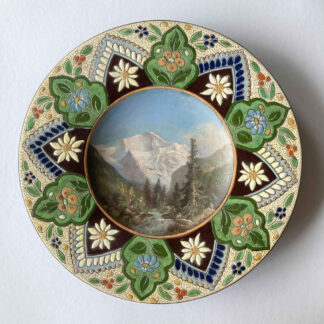
Johann WANZENRIED (* 1847, † 1895) – Wall Panel with Oil Painting – Jungfrau – Thun Majolica (Thoune)
Sold -

Johann WANZENRIED (* 1847, † 1895) – Milk Jug with Kintsugi Repair – Thun Majolica (Thoune)
$203.40incl. shipping by post
Delivery time: 7-14 days
Add to cart -

Johann WANZENRIED (* 1847, † 1895) – Dents du Midi veduta plate – Lake Geneva – Thun majolica (Thoune)
Sold -
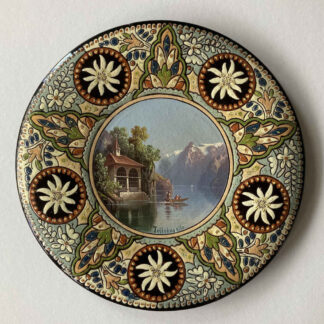
Thun ceramic plate with Tell’s chapel – Thun majolica (Thoune)
Sold
History of Thun Majolica
Thun majolica dates from the period from around 1870 to around 1914, with this Swiss ceramic genre experiencing its heyday following a successful exhibition at the Paris World Exhibition in 1878.
Its success began to wane again around 1900, although certain patterns, such as the ‘Chrutmuster’ (cabbage pattern) or the ‘Chrutdecoration’ (also known as the owl pattern) continued to live on as ‘Alt-Thun’ patterns even after the end of the ‘Thun majolica’ era. As a large proportion of Thun majolica was sold to tourists, the collapse in tourist numbers in Switzerland at the beginning of the First World War in 1914 heralded the end of this type of ceramics. After the First World War, historicism came to an abrupt end in many places, which also sealed the stylistic fate of Thun majolica.
Term ‘Thun Majolica’
The term ‘Thun majolica’ is not entirely correct for two reasons. Firstly, the ceramics referred to are not majolica in the technical sense. The ceramics referred to as Thun majolica are earthenware with multi-coloured engobing and then lead glazing, and not ceramics with a lead-tin glaze followed by a hot-fire colour application (inglaze painting). The choice of the name ‘Thun Majolica’ was probably a marketing measure by the Heimberg and Steffisburg ceramics workshops to increase sales of these ceramics with a well-sounding name.
The other reason why the term ‘Thun majolica’ is not entirely accurate is that ‘Thun majolica’ ceramics do not usually come from the town of Thun, but from ceramic workshops in Heimberg and Steffisburg, although these towns are very close to Thun.
Instead of Thun Majolica, it was also referred to as Thun ceramics, Paris crockery, Paris ware or Edelweiss crockery.
– Advertisement –

Book: Vom Heimberger Geschirr zur
Thuner Majolika
(“From Heimberg Crockery to Thun Majolica”)
Thuner Majolika
(“From Heimberg Crockery to Thun Majolica”)
Decorations & Moulds
The decorations and shapes of Thun majolica ceramics are often reminiscent of oriental ceramics. The Karlsruhe artist Franz Keller-Leuzinger, who endeavoured to improve the design of Thun majolica, had a decisive influence on the ornamental style. He modelled his ornamentation on Indian-Persian decorations, replacing the elements from the Indian plant world with Alpine rose and edelweiss. It is not for nothing that Thun majolica is sometimes called Edelweiss crockery.
The Thun majolica potters were also inspired by oriental forms, including ceramics excavated in the recently discovered city of Troy. Basically, Thun majolica is a product of the historicism art movement popular at the end of the 19th century.
Thun Veduta Plate
In addition to vases, bowls, cups, jugs, butter dishes, bonbonnières, platters (including rösti plates and cake plates), plates (including fruit plates and armorial plates), flower pots, tables, etc., Thun majolica also produces so-called veduta plates or veduta plates, also known as Thun plates. These are wall plates with oil paintings in the style of classical veduta paintings in the mirror (picture plates) and oriental patterns on the rims, which serve as a frame, whereby edelweiss elements are often incorporated into these rim patterns.
For the motifs for these oil paintings in a plate mirror, the manufacturers or painters orientated themselves on the Swiss veduta motifs already developed for tourists, which were produced on canvas, wood or cardboard, and now also on ceramics, including the following:
- Jungfrau Mountain
- Grindelwald
- Wengernalp
- Staubbach Falls in the Lauterbrunnen Valley
- Alpine hut in front of Wellhorn and Wetterhorn
- Tell’s Chapel
- Schadau Castle with Lake Thun, Blüemlisalp and Niesen
- Lake Geneva and Dents du Midi
- Chillon Castle, Lake Geneva and Dents du Midi
- Matterhorn
- Rütli oath
- Village scenes
- Scenes with hunting dogs
- Portraits (e.g., women in traditional dress)