





Scrape-me Madonna (Scraping figure)
A scrape-me Madonna is a so-called scraping figure from which believers used to scrape material off the clay. Believers assumed that the abrasion had healing powers, which is why it was sprinkled over food or animal feed.
The scrape-me Madonna figures sold here are for decorative purposes only and are not intended for use as Schab figures.
Buy a Scrape-Me Madonna
Below you will find scrape-me Madonna figures available for purchase:
-
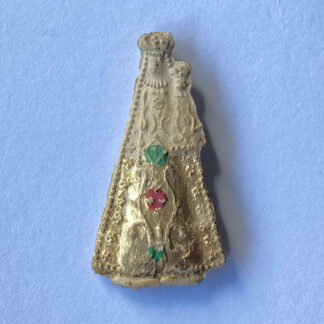
Einsiedeln Scraped Madonna in Spanish Royal Dress No. 2
$203.40Delivery time: 7-14 days
Add to cart -
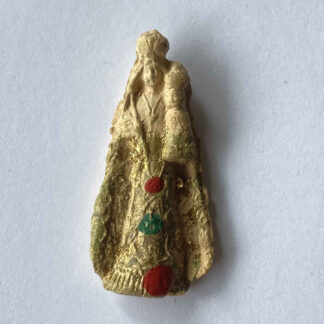
Einsiedeln Scraped Madonna in Spanish Royal Dress
Sold -
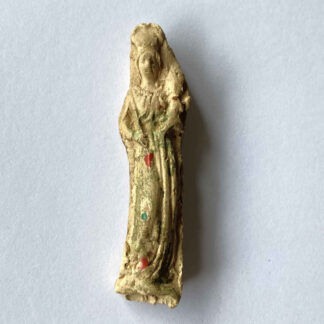
Einsiedeln Scraped Madonna No. 4
$203.40incl. shipping by post
Delivery time: 7-14 days
Add to cart -
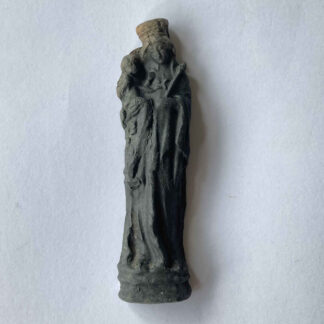
Altötting Scraped Madonna made of black-stained earthenware
$429.40incl. shipping by post
Delivery time: 7-14 days
Add to cart -
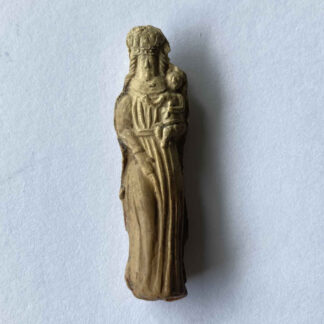
Einsiedeln Scraped Madonna with two ravens on the back
$180.80incl. shipping by post
Delivery time: 7-14 days
Add to cart -
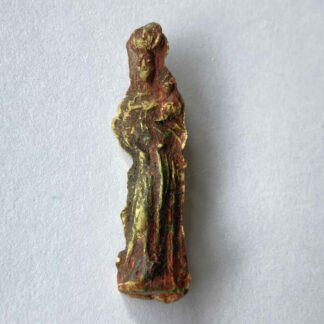
Einsiedeln Scraped Madonna No. 2
$135.60incl. shipping by post
Delivery time: 7-14 days
Add to cart -
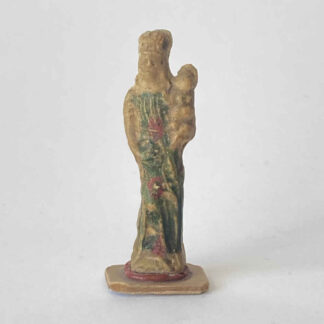
Einsiedeln Madonna as a Scraped Madonna
$203.40incl. shipping by post
Delivery time: 7-14 days
Add to cart -
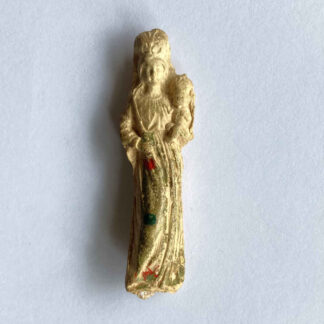
Einsiedeln Scraped Madonna with Green and Red Dots
Sold -
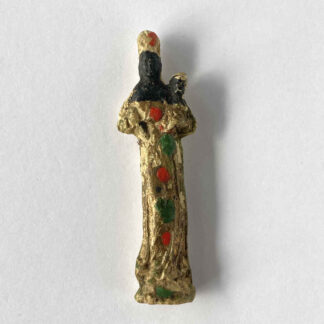
Black Madonna (Einsiedeln) as a Scraped Madonna
Sold
The term ‘Schabmadonna’ (“scrape-me Madonna”)
In some cases, the term ‘Schabemadonna’ is also used instead of ‘Schabmadonna’. The term ‘Schabmadonna’ or ‘Schabemadonna’ derives from the fact that a small amount of clay or loam was scraped off the back or the plinth of the scrape-me Madonnas in order to use it for medical purposes, amongst other things.
In the Einsiedeln dialect, they are or were also called ‘Laicheibli’, which is best translated as ‘clay figurines’ (‘Lai’ stands for clay and ‘Cheibli’ for ‘lovable woman’).
Particularly well-known are the scrape-me Madonnas from Einsiedeln (Schwyz, Switzerland), which are often painted, and those from Altötting (Upper Bavaria, Germany), which are often entirely black.
History of the Scrape-me Madonnas
Scrape-me Madonnas are classified as devotional objects; at least during the period when they were produced by the Church itself, they were consecrated and blessed by the Church. [1]
There is evidence that the scrape-me Madonnas from Einsiedeln were produced by the monastery from the 17th century onwards. One example from the art collection of Einsiedeln Abbey, for instance, bears the date 1679. However, it is likely that the production of scrape-me Madonnas began even earlier. [1]
At the time of the French invasion in 1798, the Einsiedeln monastery either produced the scrape-me Madonnas itself or authorised others to do so, as the monastery held a monopoly on the production of devotional objects, including the scrape-me Madonnas. The scrape-me Madonnas supplied by the monastery were distributed free of charge.[1]
Around 1739, the monastery issued an explicit warning in the Book of Miracles against imitations that had been sold by vendors in the monastery square.[2] Only the originals from the monastery were attributed miraculous properties by the monastery, whilst the imitations were described by the monastery as superstition. [3]
Following the French invasion, i.e. from 1798 onwards, anyone was permitted to produce scrape-me Madonnas. However, the monastery is said to have ceased production from that year onwards, having lost its monopoly on production. [7]
There are reports suggesting that scrape-me Madonnas were still being produced as late as 1920.[1] Other sources assume that they continued to be produced for much of the 20th century. [7] At present (as of 28 June 2026), scrape-me Madonnas are no longer sold in the devotional shops in Einsiedeln. [1]
The scrape-me Madonnas produced from 1798 onwards by people outside the monastery certainly do not contain any of the ‘holy’ additives, as these people had no access to them.[3]
Morphology and material properties
The size of the scrape-me Madonnas varies between 1 and 25 cm. As regards the material, it is not pure clay, but rather loam. Sources from the 18th century indicate that ‘various precious relics of the saints of God’ were mixed into the scrape-me Madonnas produced by the monastery. There is also mention of holy oil from the lamps of the Chapel of Grace and of various ‘medicinal herbs’. The literature states, amongst other things, that materials from the Chapel of Grace were added, such as dust, earth, mortar or relic dust. However, it remains unclear to this day whether, and if so, what exactly was added to the scrape-me Madonnas produced by the monastery.[2] Naturally, these components were absent from the examples produced later by private companies, as they were not available.[3]
The figurines were made in metal moulds. The clay was pressed into the moulds. After being left to dry, they were either fired in a kiln or left unfired. Those intended for use as ‘scraped Madonnas’ were left unfired, although fired examples have also been found, some of which had been partially scraped away. The fired ‘copies of miraculous images’, however, were more commonly carried around; miracles were attributed to them. Some figures, whether fired or unfired, were decorated or gilded.
If a scrape-me Madonna was damaged by the monastery during production, it was, for example, walled up inside houses, as the scrape-me Madonnas contained relics and were therefore not to be disposed of. All the scrape-me Madonnas found on the monastery grounds are unfired.[4]
Although the size of the scrape-me Madonnas can vary considerably depending on their function – ranging from 1 to 25 centimetres – [10] , they can be divided into three types: the stylised ones with a more or less circular diameter, those with a hanging ornament, and the very flat scrape-me Madonnas. As Rothkegel observed, and as evidenced by the discovery of pieces with adhesive on the reverse, the flat examples were used as collectables mounted on paper or card in the 19th and 20th centuries. [9]
Mark on the scrape-me Madonna
The scrape-me Madonnas produced by Einsiedeln Abbey bore a ‘mark of authenticity’. However, there are differing accounts of what this mark actually was. Some sources suggest it was the abbey’s coat of arms, featuring the two ravens. The fact that it is the abbey coat of arms with the two ravens – which indicates production by the monastery – is supported by the existence of a cast-iron mould that was used to stamp scrape-me Madonnas with precisely this coat of arms. It is assumed that only those scrape-me Madonnas bearing the abbey coat of arms were genuine monastery scrape-me Madonnas. [3]
However, scrape-me Madonnas have also been found which bear only two ravens on the back as a mark, i.e. without a coat of arms. In this case, it is reasonable to assume that these scrape-me Madonnas were produced by people outside the monastery, either as counterfeit imitations up to 1798 or as items produced after the end of the monastery’s monopoly on the manufacture of scrape-me Madonnas from 1798 onwards.[3]
However, referring to the scrape-me Madonnas located in the canton of Zug, Rüdiger Rothkegel suggests that, in the case of the examples depicting ravens, the shield section may have been lost. [8] Rothkegel also posits that, given the long period over which the moulds were in use, the absence of details such as the coat of arms is a possibility. [9] It is, however, unlikely that the monastery would have issued scrape-me Madonnas on which the coat of arms was not recognisable, given that the monastery’s very aim was to distinguish itself from the competition. It is also unlikely that, over time, the entire coat of arms surrounding the ravens would have completely worn away, whilst the ravens themselves remain well preserved.
Some scrape-me Madonnas bear the initials ‘PO’; these refer to the artist Peter Ochsner, who lived from 1809 to 1865, meaning that his scrape-me Madonnas can no longer be associated with the monastery.
The use of the scrape-me Madonnas
The scrape-me Madonnas were used both for healing purposes and as copies of miraculous images.
For healing purposes, material was scraped from the back or the plinth, and the scraped powder was then ingested, for example in water or mixed into a meal. The scraped powder from the scrape-me Madonnas was also administered to sick animals. [5]
When used as copies of images of grace, the scrape-me Madonnas were buried in the ground during the construction of houses, set into walls or embedded in roof beams. Alternatively, people carried them with them, for example by storing them in small capsules that could be attached to a rosary. In some cases, scrape-me Madonnas were also incorporated into reliquary boxes.[5]
The Book of Miracles and the Einsiedel Chronicle recount numerous miraculous stories. Copies of the miraculous image were also often used to protect women in labour. They were also placed in infants’ cradles and sewn into children’s bedding. A scrape-me Madonna was also found at a burial site dating from 1695. The Fribourg pilgrimage site of Notre-Dame du Bois originated in a spot in a wood where a man had placed a scrape-me Madonna and decorated it with flowers. [6]
Sources
[1] Marty, Evelyne: „Laicheibli“: Analyse und Typologie der Schabmadonnen-Funde aus, in: Mittelalter : Zeitschrift des Schweizerischen Burgenvereins = Moyen Age : revue de l’Association Suisse Châteaux Forts = Medioevo : rivista dell’Associazione Svizzera dei Castelli = Temp medieval : revista da l’Associaziun Svizra da Chastels, volume 26 (2021), issue 4, p. 184.
[2] Marty, Evelyne: „Laicheibli“: Analyse und Typologie der Schabmadonnen-Funde aus, in: Mittelalter : Zeitschrift des Schweizerischen Burgenvereins = Moyen Age : revue de l’Association Suisse Châteaux Forts = Medioevo : rivista dell’Associazione Svizzera dei Castelli = Temp medieval : revista da l’Associaziun Svizra da Chastels, volume 26 (2021), issue 4, p. 185.
[3] Marty, Evelyne: „Laicheibli“: Analyse und Typologie der Schabmadonnen-Funde aus, in: Mittelalter : Zeitschrift des Schweizerischen Burgenvereins = Moyen Age : revue de l’Association Suisse Châteaux Forts = Medioevo : rivista dell’Associazione Svizzera dei Castelli = Temp medieval : revista da l’Associaziun Svizra da Chastels, volume 26 (2021), issue 4, p. 186.
[4] Marty, Evelyne: „Laicheibli“: Analyse und Typologie der Schabmadonnen-Funde aus, in: Mittelalter : Zeitschrift des Schweizerischen Burgenvereins = Moyen Age : revue de l’Association Suisse Châteaux Forts = Medioevo : rivista dell’Associazione Svizzera dei Castelli = Temp medieval : revista da l’Associaziun Svizra da Chastels, volume 26 (2021), issue 4, p. 196.
[5] Marty, Evelyne: „Laicheibli“: Analyse und Typologie der Schabmadonnen-Funde aus, in: Mittelalter : Zeitschrift des Schweizerischen Burgenvereins = Moyen Age : revue de l’Association Suisse Châteaux Forts = Medioevo : rivista dell’Associazione Svizzera dei Castelli = Temp medieval : revista da l’Associaziun Svizra da Chastels, volume 26 (2021), issue 4, p. 187.
[6] Marty, Evelyne: „Laicheibli“: Analyse und Typologie der Schabmadonnen-Funde aus, in: Mittelalter : Zeitschrift des Schweizerischen Burgenvereins = Moyen Age : revue de l’Association Suisse Châteaux Forts = Medioevo : rivista dell’Associazione Svizzera dei Castelli = Temp medieval : revista da l’Associaziun Svizra da Chastels, volume 26 (2021), issue 4, p. 182.
[7] Rothkegel, Rüdiger: „Mittelalterliche und neuzeitliche Tonstatuetten aus dem Kanton Zug“: Analyse und Typologie der Schabmadonnen-Funde aus, in: Zeitschrift für schweizerische Archäologie und Kunstgeschichte = Revue suisse d’art et d’archéologie = Rivista svizzera d’arte e d’archeologia = Journal of Swiss archeology and art history, volume 63 (2026), issue 2, p. 156.
[8] Rothkegel, Rüdiger: „Mittelalterliche und neuzeitliche Tonstatuetten aus dem Kanton Zug“: Analyse und Typologie der Schabmadonnen-Funde aus, in: Zeitschrift für schweizerische Archäologie und Kunstgeschichte = Revue suisse d’art et d’archéologie = Rivista svizzera d’arte e d’archeologia = Journal of Swiss archeology and art history, volume 63 (2026), issue 2, p. 157.
[9] Marty, Evelyne: „Laicheibli“: Analyse und Typologie der Schabmadonnen-Funde aus, in: Mittelalter : Zeitschrift des Schweizerischen Burgenvereins = Moyen Age : revue de l’Association Suisse Châteaux Forts = Medioevo : rivista dell’Associazione Svizzera dei Castelli = Temp medieval : revista da l’Associaziun Svizra da Chastels, volume 26 (2021), issue 4, p. 188.
[10] Marty, Evelyne: „Laicheibli“: Analyse und Typologie der Schabmadonnen-Funde aus, in: Mittelalter : Zeitschrift des Schweizerischen Burgenvereins = Moyen Age : revue de l’Association Suisse Châteaux Forts = Medioevo : rivista dell’Associazione Svizzera dei Castelli = Temp medieval : revista da l’Associaziun Svizra da Chastels, volume 26 (2021), issue 4, p. 189.