


Description
Type: painting
Painter: Hedwig Scherrer (* 1878, † 1940)
Object: oil crayon drawing
Material: oil crayon on paper
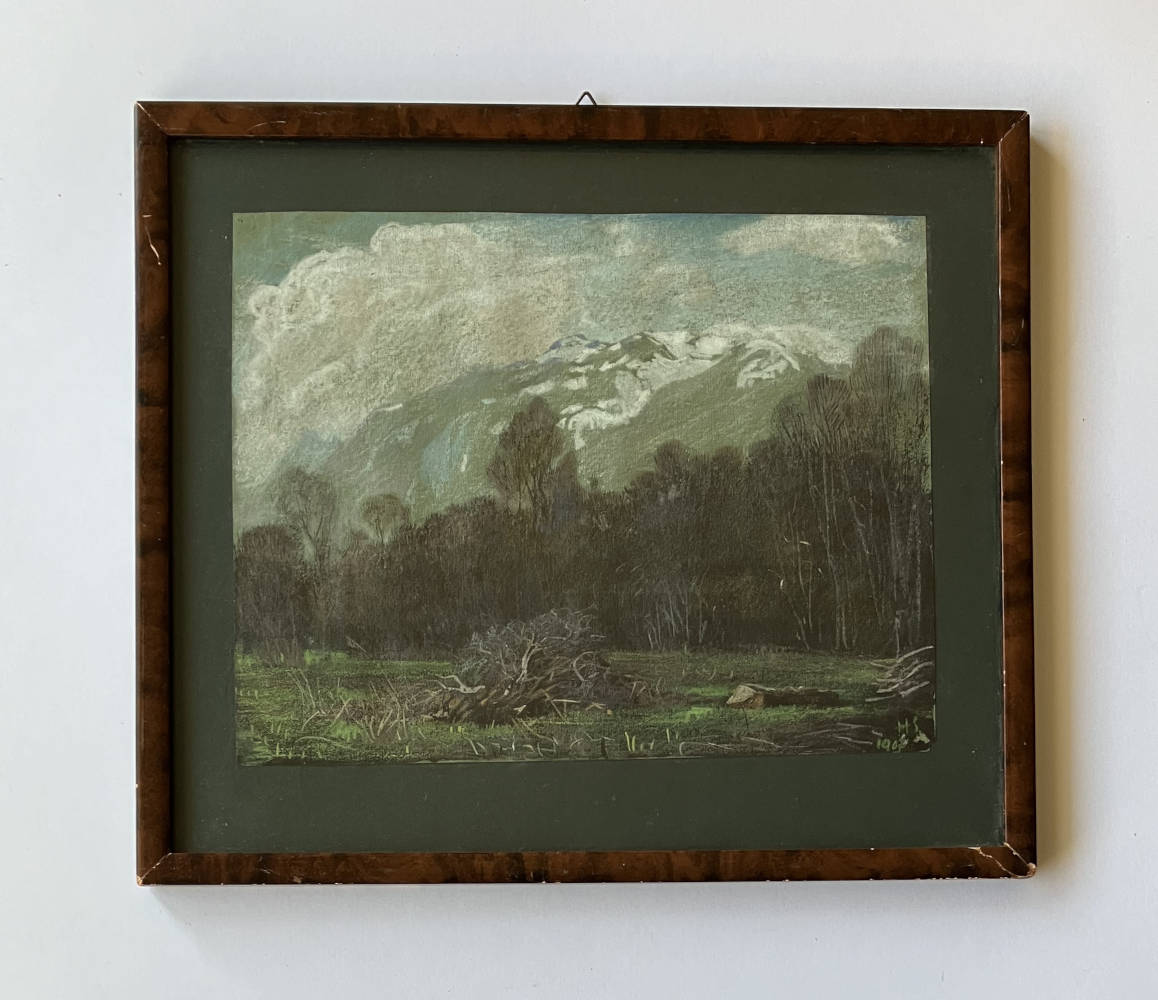
Dimensions: height: 17.5 cm, width: 23 cm; with frame: height: 25.5 cm, width: 29 cm
Year of production: 1907
Catalogue raisonné inventory number: L-337-P
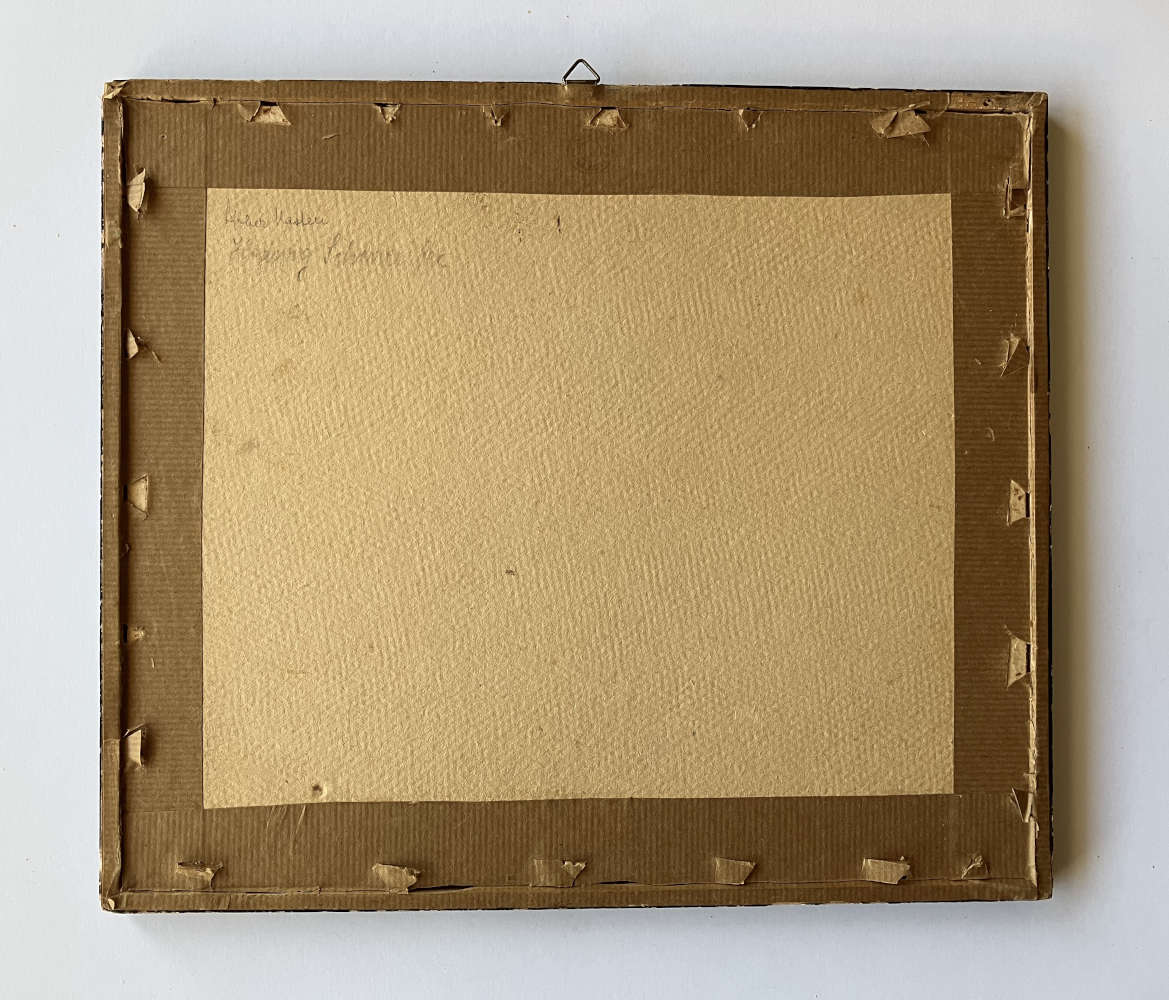
Condition: picture: paper slightly wavy, a small piece of the lower right corner is missing, sheet is glued to coloured cardboard, which Hedwig Scherrer often did for her miniatures; frame: partially broken, bumped and rubbed; back cover: adhesive tape cut open for opening and pieces of the adhesive tape are partially missing.
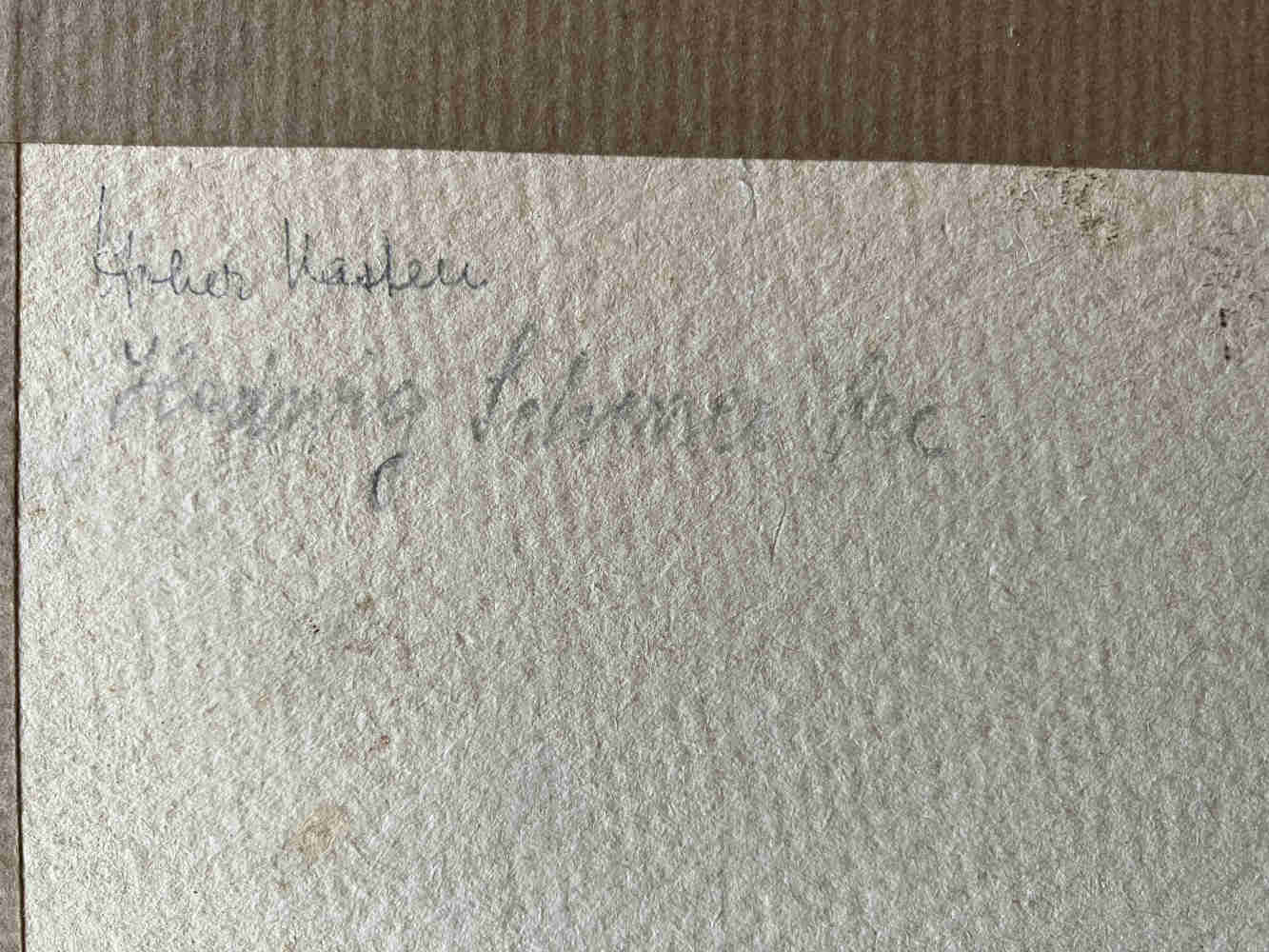
Signature: monogrammed and dated by the artist on the picture: HS 1907; inscribed in an unknown hand on the reverse: Hoher Kasten, Hedwig Scherrer fec
Details:
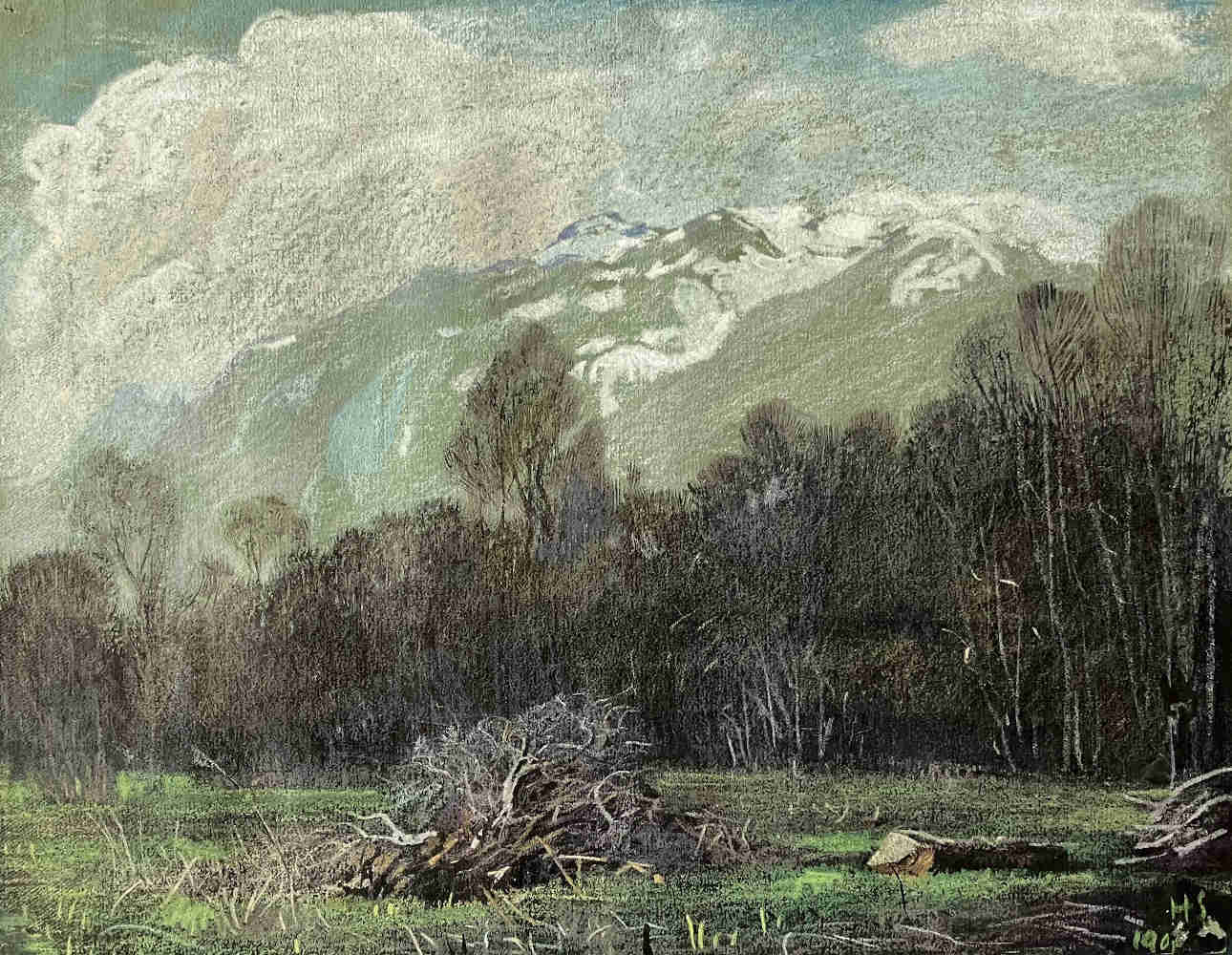
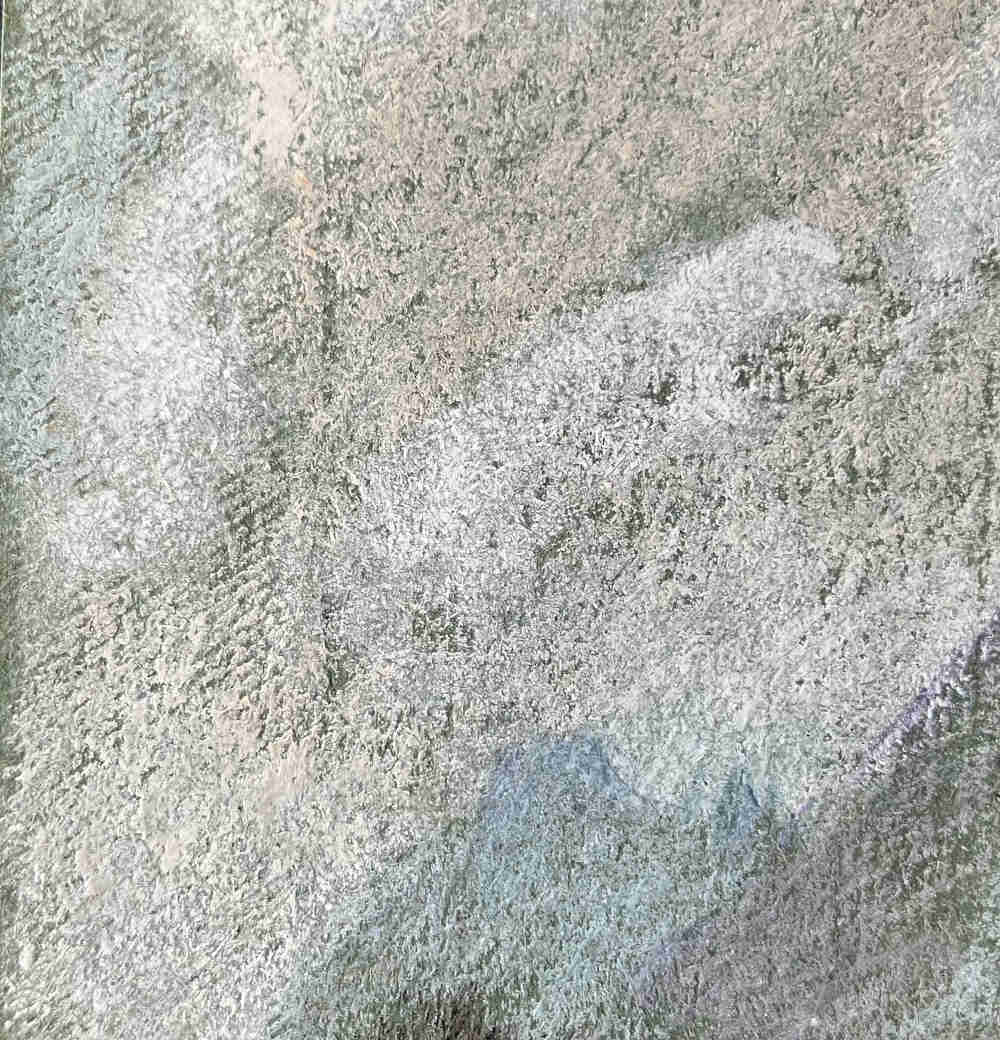
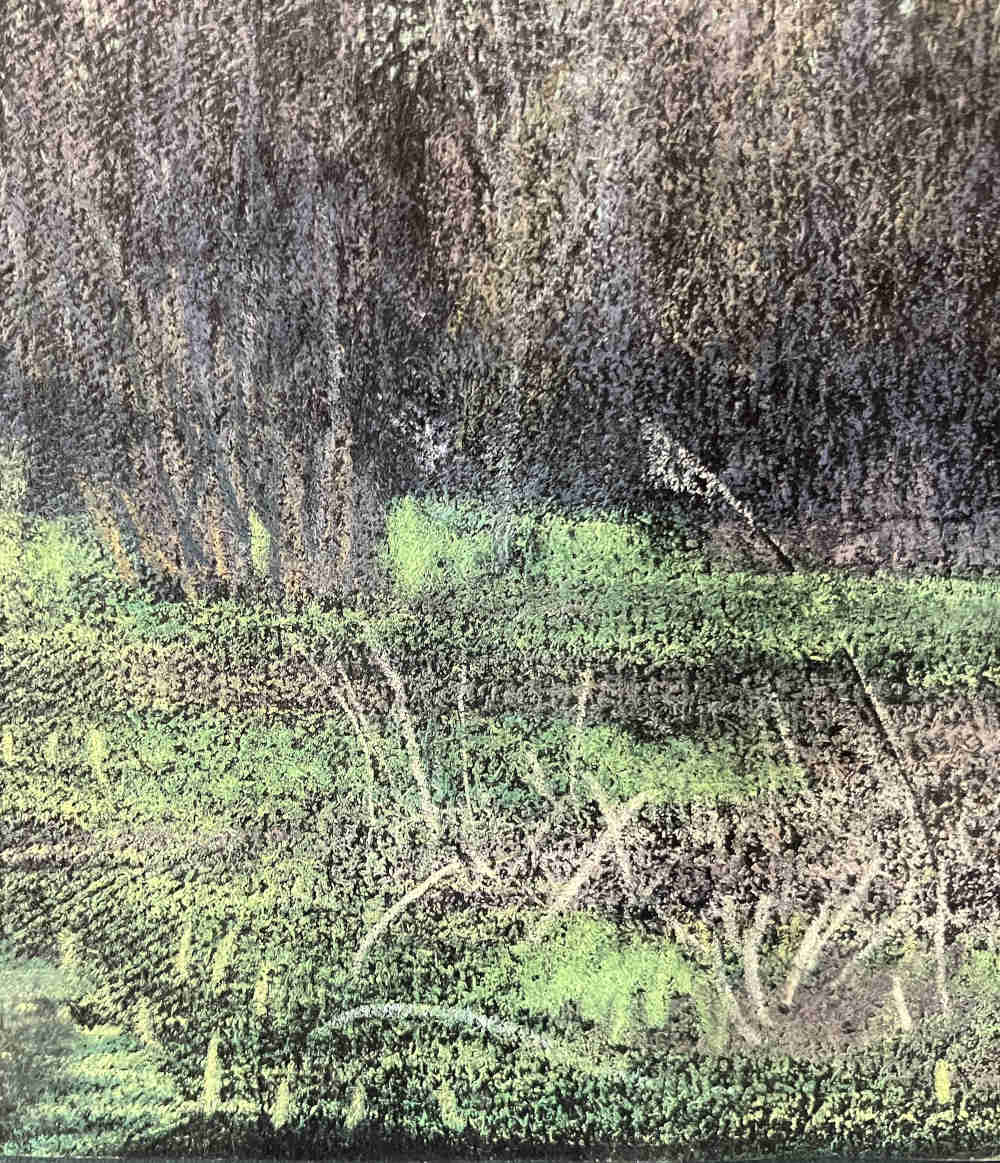
This painting of the Hoher Kasten by Hedwig Scherrer from 1907 looks like a mixture of the Art Nouveau painting of a Ferdinand Hodler and the Paysage intime of a Barthélemy Menn with a tendency towards naturalism and filigree richness of detail.
The picture was probably painted with oil pastels and on paper. Hedwig Scherrer often used individual sheets of paper when painting, which she attached to a firm base with drawing pins. The partially straight, parallel line structures in the painting are therefore very probably the result of the support on which Scherrer had fixed the sheet with drawing pins. At the top left you can still see a small hole from a drawing pin and the missing corner at the bottom right is probably also the result of the drawing pin fastening.
This painting of the Hoher Kasten was included by the Hedwig Scherrer Foundation in the catalogue raisonné of Hedwig Scherrer with the inventory number (inv. no.) L-337-P.
The motif of the picture is a view of the Hoher Kasten. The Hohe Kasten is a mountain in the Alpstein of the Appenzell Alps, which lies on the cantonal border between the Swiss cantons of St. Gallen and Appenzell Innerrhoden.
This is probably a view of the Hoher Kasten near the Oberriet-Meiningen border crossing in the direction of Rüthi (see here on Google Maps).
Between 1906 and 1908, an Art Nouveau artist’s house was built for Hedwig Scherrer in Montlingen (Oberriet) in the neighbouring municipality of Rüthi according to Hedwig Scherrer’s plans; the so-called “Villa Scherrer”. The ingeniously designed house features murals and furniture by H. Scherrer. The Hedwig Scherrer House still exists today at the following address, but is not open to the public:
Hedwig Scherrer Haus
Bergliweg 17
9462 Montlingen
The Hedwig Scherrer House was built on a plot of land from an abandoned vineyard. The municipality of Rüthi (formerly known as ‘Rüthi (Rheintal)’) had also applied for Hedwig Scherrer’s residence when the municipality learnt that the artist wanted to settle in the area. The municipality of Rüthi hoped that Hedwig Scherrer would design postcards relating to Rüthi. But in the end, Scherrer decided in favour of Montlingen.
By building a house in the countryside far away from the city of St. Gallen, Hedwig Scherrer was following a trend that was also becoming established in Munich at the time, when artists were flocking from the city to the countryside and settling in Dachau, for example, where an artists’ colony was forming. In particular, these artists followed the fashion of painting landscapes in the open air. This so-called open-air painting (en-plein-air painting, plein-air painting, plein-airism), as opposed to pure studio painting, emerged in France through the Barbizon School, an artists’ colony in the village of Barbizon, which is located near Paris.
Hedwig Scherrer became acquainted with the St. Gallen Rhine Valley, where Montlingen is located, during her research for the Zentenar volume ‘Der Kanton St. Gallen 1803-1903’, for which Scherrer had designed illustrations.
Sources:
– Website ‘Montlinger Bergli’: Hedwig Scherrer Haus
– Website of the municipality of Oberriet: Hedwig Scherrer Haus
– Peter Zünd (Curator of the Hedwig Scherrer Foundation)